RSS

September 2025 Residential Market Report

Fall market favours buyers  

Another Bank of Canada rate cut and easing prices helped home sales registered on the MLS® in Metro Vancouver edge higher relative to September last year.  

The Greater Vancouver REALTORS® (GVR) reports that residential sales in the region totalled 1,875 in September 2025, a 1.2 per cent increase from the 1,852 sales recorded in September 2024. This was 20.1 per cent below the 10-year seasonal average (2,348).  

“With another cut to Bank of Canada’s policy rate behind us, and markets pricing in at least one more cut by the end of the year, Metro Vancouver homebuyers have reason to be optimistic about the fall market,” said Andrew Lis, GVR’s director of economics and data analytics.  “Easing prices, near-record high inventory levels, and increasingly favourable borrowing costs are offering those looking to purchase a home this fall with plenty of opportunity.”   

There were 6,527 detached, attached and apartment properties newly listed for sale on the Multiple Listing Service® (MLS®) in Metro Vancouver in September 2025. This represents a 6.2 per cent increase compared to the 6,144 properties listed in September 2024. This was 20.1 per cent above the 10-year seasonal average (5,434).  

The total number of properties currently listed for sale on the MLS® system in Metro Vancouver is 17,079, a 14.4 per cent increase compared to September 2024 (14,932). This is 36.1 per cent above the 10-year seasonal average (12,553).  

Across all detached, attached and apartment property types, the sales-to-active listings ratio for September 2025 is 11.3 per cent. By property type, the ratio is 8.5 per cent for detached homes, 12.7 per cent for attached, and 13.3 per cent for apartments.  

Analysis of the historical data suggests downward pressure on home prices occurs when the ratio dips below 12 per cent for a sustained period, while home prices often experience upward pressure when it surpasses 20 per cent over several months. 

“The past few years have been quite challenging for the market, beginning with 2022’s rapid increase in interest rates, major political and policy shifts in subsequent years, and recent trade tensions with the USA weighing on the market,” Lis said. “With the acute impacts of these events now fading, we expect market activity to continue stabilizing to end the year, barring any unforeseeable major disruptions.”  

The MLS® Home Price Index composite benchmark price for all residential properties in Metro Vancouver is currently $1,142,100. This represents a 3.2 per cent decrease over September 2024 and a 0.7 per cent decrease compared to August 2025.  

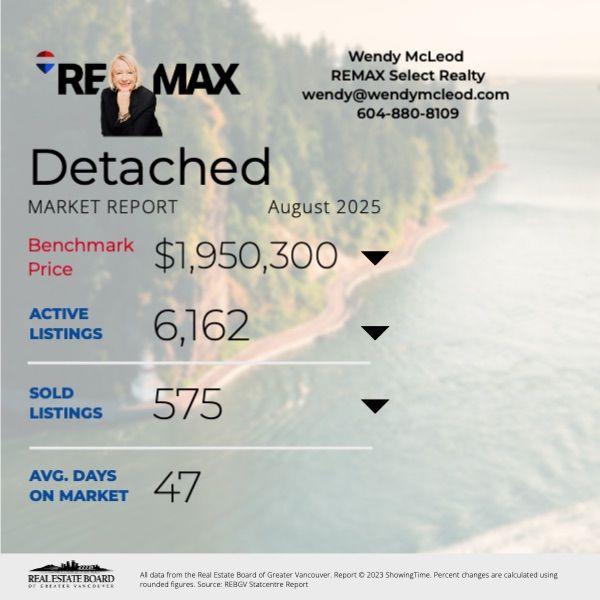
Sales of detached homes in September 2025 reached 552, a 7 per cent increase from the 516 detached sales recorded in September 2024. The benchmark price for a detached home is $1,933,100. This represents a 4.4 per cent decrease from September 2024 and a 0.9 per cent decrease compared to August 2025.  

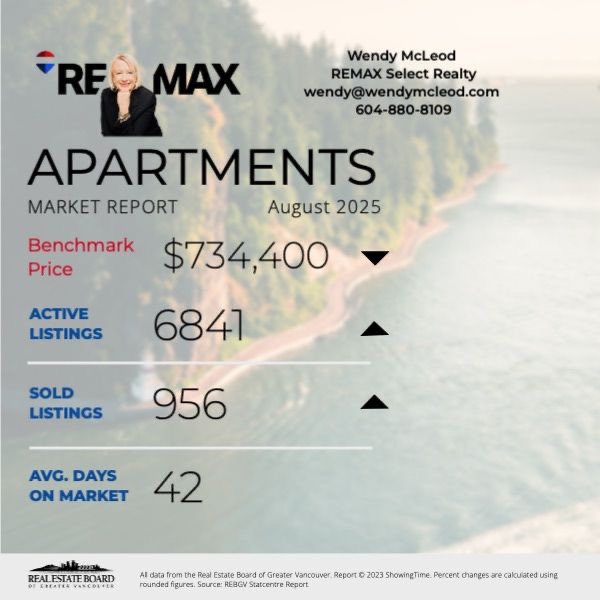
Sales of apartment homes reached 954 in September 2025, a 1.5 per cent increase compared to the 940 sales in September 2024. The benchmark price of an apartment home is $728,800. This represents a 4.4 per cent decrease from September 2024 and a 0.8 per cent decrease compared to August 2025.   

Attached home sales in September 2025 totalled 356, a 5.8 per cent decrease compared to the 378 sales in September 2024. The benchmark price of a townhouse is $1,069,800. This represents a 2.7 per cent decrease from September 2024 and a 0.9 per cent decrease compared to August 2025. 

Download the September 2025 GVR Residential Market Report. 

Read

Inflation Stronger than Expected

Canadian Inflation Stronger Than Expected

The Consumer Price Index (CPI) rose 2.4% on a year-over-year basis in September, up from a 1.9% increase in August. The acceleration in headline inflation from 1.9% in August was also larger than the median projection in a Bloomberg survey of economists, which was 2.2%.

On a year-over-year basis, gasoline prices fell less in September (-4.1%) compared with August (-12.7%) due to a base-year effect, leading to an acceleration in headline inflation. Excluding gasoline, the CPI rose 2.6% in September, after increasing 2.4% in August.

A slower year-over-year decline in prices for travel tours (-1.3%) and a larger increase in prices for food purchased from stores (+4.0%) also contributed to the upward pressure in the all-items CPI in September.

The CPI rose 0.1% month over month in September. On a seasonally adjusted monthly basis, the CPI was up 0.4%.

Gasoline prices fell 4.1% year over year in September after a 12.7% decrease in August. The smaller year-over-year decline was primarily due to a base-year effect. In September 2024, prices fell 7.1% month over month due, in part, to lower crude oil prices amid growing concerns of weaker economic growth, particularly in China and the United States. In September 2025, gasoline prices rose 1.9% monthly following refinery disruptions and maintenance in the United States and Canada, which put upward pressure on prices. 

On a year-over-year basis, prices for travel tours fell 1.3% in September following a 9.3% decline in August. Despite typically declining on a month-over-month basis in September, travel tour prices rose 4.6% in the month. This was a result of higher prices for destinations in Europe and some parts of the United States, as significant events in destination cities put upward pressure on hotel prices.

Consumers paid 4.0% more year over year for food purchased from stores in September, following a 3.5% increase in August. Faster price growth was driven by increased prices for fresh vegetables (+1.9% in September, compared with -2.0% in August) and sugar and confectionery (+9.2% in September, compared with +5.8% in August).

Year-over-year grocery price inflation has generally trended upward since its most recent low in April 2024 (+1.4%). Grocery items contributing to the general acceleration included fresh or frozen beef and coffee, both due, in part, to lower supply.

Tuition fees, priced annually in September, increased 1.7% in 2025 compared with a 1.8% increase in 2024. Aside from 2019, the 2025 increase was the smallest since 1976, when the index was unchanged (0.0%).

In 2025, students from Prince Edward Island (+4.7%) experienced the largest price increase. At the same time, students from Nova Scotia (+1.1%) and Ontario (+1.1%) had the smallest increase, coinciding with a freeze on tuition fees in both provinces.

Bank of Canada Deputy Governor Rhys Mendes recently warned that traders may be putting too much emphasis on its two “preferred” core inflation measures, the so-called trim and median gauges.

In September, both CPI-median and CPI-trim came in hotter than economists were expecting. The average of these metrics was 3.15% in September, while the three-month moving average accelerated to 2.7%.

Mendes said the central bank is weighing a broader suite of gauges that suggest underlying price pressures are closer to its 2% target.

Shelter inflation rose 2.6% on an annual basis, while CPI excluding food and energy was 2.4%. CPI excluding eight volatile components and indirect taxes was 2.8%, up from 2.6%.

CPI excluding taxes accelerated to 2.9% from 2.4% the previous month.

The share of components within the consumer price index basket that are rising 3% and higher — another key metric that policymakers are watching closely — declined slightly to 38%.

All 10 Canadian provinces saw prices rising at a faster year-over-year pace in September compared with August. Quebec experienced the steepest price growth, reaching 3.3% last month.

Rent prices also accelerated nationally to 4.8%, led by a 9.8% increase in Quebec. Slower rent price growth of 1.8% in British Columbia moderated the national increase, the report noted.

Bottom Line

The report shows that underlying price pressures remain elevated, raising questions about how quickly the central bank can proceed with rate cuts to aid the tariff-hit economy. 

Still, the acceleration in headline and most core measures was driven by a gasoline price base-year effect — a possible reason for analysts to look through the print.

Traders in overnight swaps pared bets on a rate cut next week, lowering the odds to about 65% from close to 80% before the report. The loonie jumped to the day’s high against the US dollar. Canadian debt fell across the curve, with the two-year yield rising about three basis points to a session high at 2.38%.

The ongoing trade war with the US drove the Bank of Canada to lower its policy rate by a quarter of a percentage point to 2.5% in September, marking the first cut in six months.

During their deliberations last month, some members of its governing council argued that more support would likely be needed given the softness in the economy, notably if the labour market weakened further.

Bank of Canada Governor Tiff Macklem recently described Canada’s labour market as “soft,” despite data showing the country added 60,400 jobs in September, which only partially reversed a decline of more than 100,000 positions over the previous two months.

The central bank will have to weigh recent economic weakness against concerns about firm core inflation over the past few months. The BoC will cut the overnight policy rate again by 25 bps to 2.25%, responding to its concern for the sectors hardest hit by tariffs, along with a housing market suffering from negative household psychology and overbuilding in the GTA and GVA.

Dr. Sherry Cooper
Chief Economist, Dominion Lending Centres
drsherrycooper@dominionlending.ca

Read

Welcome to PH2 2091 Vine Street, Vancouver, BC

Welcome to this Penthouse in the heart of Kitsilano. Just steps to the vibrant West 4th avenue and all its cafes, boutiques, grocery stores, restaurants and pretty much anything you wnt, including a short walk to Kits Beach and pool. 2 bedrooms and 2 bath home with views to the North Shore, 2 parking and a locker.  Great for upsizers or downsizers.

Read

 Bank of Canada Cuts Rate to 2.50% — What It Means for  You

The Bank of Canada has just lowered its policy rate by 25 basis points to 2.50% — the lowest in three years. This move is big news for our real estate market here in Vancouver. Let’s look at what’s driving the cut and, more importantly, what it means if you’re buying or selling.

Why the Rate Was Cut

  • Slowing economy: GDP slipped ~1.6% in Q2.

  • Job market softening: Rising unemployment is a concern.

  • Inflation cooling: Still a touch high at the core, but trending down.

  • Global uncertainties: Tariffs and trade pressures are weighing on growth.

What It Means for Buyers

  • Lower borrowing costs: Variable-rate mortgages and loans tied to prime should ease.

  • Fixed-rate relief: Fixed mortgages may dip as bond yields adjust.

  • More purchasing power: Lower payments could let you aim higher or simply buy with more comfort.

  • Increased competition: More buyers entering the market means hot listings could see multiple offers — being pre-approved is key.

What It Means for Sellers

  • Bigger buyer pool: Lower rates invite more demand.

  • Quicker sales: Homes may move faster, especially in desirable neighbourhoods.

  • Stronger pricing power: More buyers can mean stronger offers — though local inventory levels matter.

  • Great timing to move up: If you’re selling and buying again, lower rates make upgrading more attractive.

A Few Things to Keep in Mind

  • This is a modest cut — it helps, but affordability challenges remain.

  • Fixed rates don’t always move right away. Locking in now could be a smart hedge.

  • Rate cuts can reverse if inflation heats up or the economy worsens.

  • Every market is different — what we’re seeing in Vancouver might not mirror other regions.


This rate cut creates momentum. Whether you’re thinking of buying, selling, or simply watching the market, it’s a great time to explore your options.

If you’d like to know how this change impacts your specific situation, let’s connect — I’d be happy to walk you through the numbers.

Wendy McLeod, Vancouver Realtor — your trusted guide in every market.


Read

The Bank of Canada drops the Interest Rate to 2.5%

Bank of Canada lowers policy rate to 2½%

FOR IMMEDIATE RELEASE

Media Relations

Ottawa, Ontario

September 17, 2025

Today, the Bank of Canada lowered the overnight policy rate by 25 bps to 2.5% as was widely expected. Following yesterday's better-than-expected inflation report, the Bank believes that underlying inflation was 2.5% year-over-year.

Through the recent period of tariff turmoil, the Governing Council has closely monitored the risks and uncertainties facing the Canadian economy. Three developments triggered the Bank's rate cut. Canada's labour market softened further. Upward pressure on underlying inflation has diminished, and there is less upside to risk to future inflation with the removal of most retaliatory tariffs by Canada. 

Considerable uncertainty remains. However, with a weaker economy and less upside risk to inflation, the Governing Council deemed that a reduction in the policy rate was appropriate to better balance the risks going forward.

"The Bank will continue to assess the risks, look over a shorter horizon than usual, and be ready to respond to new information."

Today's press release suggests that the global economy has slowed in response to trade disputes. In the US, business investment has been substantial, primarily driven by expenditures on Artificial Intelligence. However, consumers are cautious, and employment gains have slowed. It is nearly a certainty that the Federal Reserve will lower its overnight policy rate this afternoon. 

"Growth in the euro area has moderated as US tariffs affect trade. China's economy held up in the first half of the year, but growth appears to be softening as investment weakens. Global oil prices are close to their levels assumed in the July Monetary Policy Report (MPR). Financial conditions have continued to ease, with higher equity prices and lower bond yields. Canada's exchange rate has been stable relative to the US dollar."

Canada's economy contracted in the second quarter, posting a growth rate of -1.6%. Exports fell by 27% in Q2 following a surge in exports in advance of tariffs in Q1. Business investment also fell in Q2. "In the months ahead, slow population growth and the weakness in the labour market will likely weigh on household spending."

Employment has declined in the past two months. "Job losses have largely been concentrated in trade-sensitive sectors, while employment growth in the rest of the economy has slowed, reflecting weak hiring intentions. The unemployment rate has moved up since March, hitting 7.1% in August, and wage growth has continued to ease."

Bottom Line

The Bank of Canada was pretty tight-lipped about future rate cuts, but given the current trajectory, we expect another rate cut when they meet again this fall. The next BoC decision date is October 29, and the central bank wraps up the year on December 10. We expect at least one more rate cut this year, ending the year with a policy rate of 2.0%-2.25%. This should help boost interest-sensitive spending, most particularly housing, where there is considerable pent-up demand.

The Bank will move cautiously, but with the Fed cutting rates again later this year, this gives the BoC cover. While some have questioned the Bank's easing in the face of 3% core inflation, other inflation measures suggest that underlying inflation is roughly 2.5%. The economic and labour market slowdown bodes well for another rate cut. 

Traders in overnight swaps continue to price in another cut from the central bank this cycle, and put the odds at about a coin flip that they'll ease again in October.

The central bank's communications suggest that while it has resumed monetary easing to support the ailing economy, it is leery of cutting interest rates too quickly, given the potential inflation risks posed by the surge in global protectionism and tariffs.


Read

Economists split on BoC’s next rate move after July inflation data

By The Canadian Press

Economists say they found some encouraging signs in the latest inflation numbers but some warn the Bank of Canada might need a bit more convincing to cut its key interest rate next month.

The annual rate of inflation fell to 1.7 per cent in July, Statistics Canada said Tuesday, down from 1.9 per cent in June. The reading was a tenth of a percentage point below most economists’ expectations.

A 16.1 per cent decline year-over-year in gas prices tied mainly to the removal of the consumer carbon price earlier this year fuelled the drop.

BMO chief economist Doug Porter said in an interview that the July consumer price index was a “relatively favourable report” despite some stubbornness at the grocery store and in housing.

July’s consumer price index marks the first of two looks at inflation that the Bank of Canada will get before its next interest rate decision on Sept. 17. The central bank held its policy rate steady at 2.75 per cent in July.

The Bank of Canada has been looking for signs of how Canada’s tariff dispute is affecting inflation, and is particularly concerned with trends in core inflation that strip out influences from tax changes and other volatile inputs.

Statistics Canada said the Bank of Canada’s preferred measures of core inflation held around three per cent in July.

Porter pointed out that another measure of core inflation that strips out influences from food and energy was lower in July, around 2.6 per cent.

Looking at those readings, he said the July CPI report “slightly turned the dial” toward a rate cut in September, aligning with BMO’s expectations.

Financial market odds for a quarter-point rate cut in September increased modestly to around 40 per cent as of Tuesday afternoon, according to LSEG Data & Analytics.

But with core inflation still elevated compared with the headline figure, Porter acknowledged BMO’s call for a cut next month was “a long shot” at this point.

“We need some help in the inflation numbers. We probably need a relatively sluggish jobs number as well,” he said.

CIBC senior economist Andrew Grantham said in a note that the lack of easing in core inflation can mostly be attributed to the base-year effect -- the distortion from price movements last year on a particular month’s annual inflation comparisons.

He said the shorter-term, three-month core inflation readings now show an annualized rate of 2.4 per cent for July.

Grantham said there’s still more data to come before the Bank of Canada’s next rate decision, but the July inflation figures support his call for a quarter-point cut in September.

RBC, meanwhile, is maintaining its call for no more interest rate cuts from the Bank of Canada this year.

Claire Fan, senior economist with RBC, said in a note that the monthly advance in core inflation was less than she was expecting. But she said pressure is still spread broadly through the consumer price index.

Inflation on food from the grocery store accelerated to 3.4 per cent annually in July, up from 2.8 per cent in June.

Confectionary prices rose 11.8 per cent and coffee gained 28.6 per cent to be among the biggest contributors to food inflation last month.

Statistics Canada said poor growing conditions in countries that produce cocoa and coffee beans were to blame for higher costs.

Prices for fresh grapes were up nearly 30 per cent, driving the overall cost for fresh fruit up 3.9 per cent in July compared with 2.1 per cent in June.

Porter said there are some hints that Canada’s tariff dispute with the United States is a factor keeping food inflation elevated, but he stopped short of blaming it for pain at the grocery store.

“I think the bigger story is coffee prices ... chocolate prices and beef prices, and those aren’t really a tariff story. Those are more climate issues,” he said.

Tariffs from the U.S. are driving a bit of “stickiness” in durable goods inflation, Porter noted, particularly in motor vehicles.

In addition to duties placed on some Canadian inputs, U.S. tariffs on vehicles from around the world are driving some “spillover” effects on inflation in Canada, he said.

“The trade war has had an effect on auto prices and autos are a big share of the CPI,” he said.

“So yes, unfortunately we have not totally escaped the trade war in our inflation data.”

Shelter inflation also saw a modest acceleration to three per cent last month from 2.9 per cent in June, marking the first increase in the category since February 2024.

Rent price growth picked up in July, particularly in Prince Edward Island, Newfoundland and Labrador and British Columbia. Lower mortgage costs are still moderating the overall increase in shelter inflation.

Prices for natural gas fell to a lesser degree than in June, thanks mostly to higher costs in Ontario.

Porter said the stubbornness in shelter inflation has been “frustrating,” but market data continues to show rent dropping in major cities across Canada, so he expects further easing in this CPI component through the rest of the year.

This report by The Canadian Press was first published Aug. 19, 2025.

By Craig Lord

Read
Reciprocity Logo The data relating to real estate on this website comes in part from the MLS® Reciprocity program of either the Greater Vancouver REALTORS® (GVR), the Fraser Valley Real Estate Board (FVREB) or the Chilliwack and District Real Estate Board (CADREB). Real estate listings held by participating real estate firms are marked with the MLS® logo and detailed information about the listing includes the name of the listing agent. This representation is based in whole or part on data generated by either the GVR, the FVREB or the CADREB which assumes no responsibility for its accuracy. The materials contained on this page may not be reproduced without the express written consent of either the GVR, the FVREB or the CADREB.